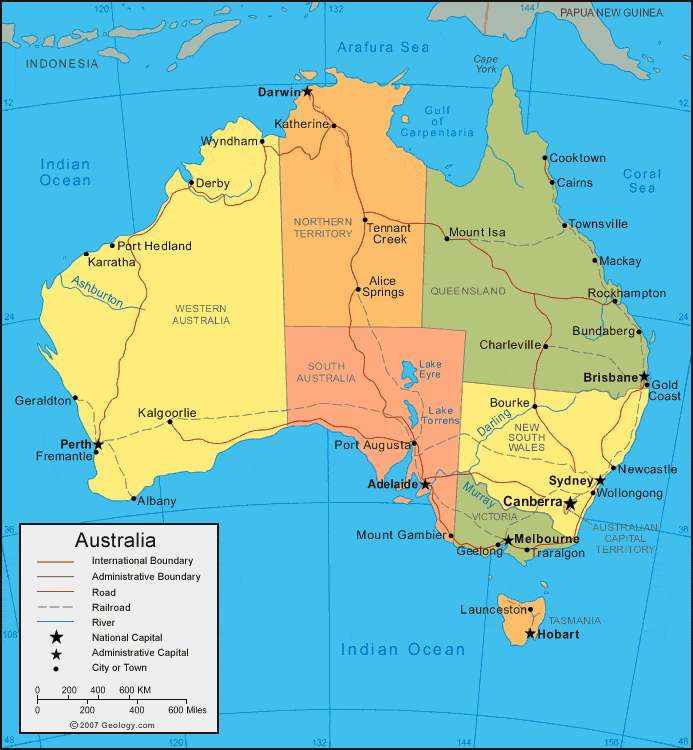
people of Queensland relies on a continuous supply of energy to maintain their quality of life, comfort and welfare. Energy is also the life blood of trade, production and overall economy. However, traditional energy sources are getting afraid and have a negative impact on the environment. Will you return to Queensland in the dark ages when there is no power? Or will it remain forever dependent on the Queensland power which exacts a high price against the environment?
Queensland Government does not think so. It has established the Office of Clean Energy to accelerate the development and implementation of alternative renewable energy infrastructure. Adding more muscle to this initiative, the Queensland Renewable Energy Plan (QREP) was launched last June 2009 for the implementation of renewable energy infrastructure throughout Queensland. Furthermore, ClimateSmart 2050 strategy has been launched to continue to clean and green energy sources, in order to achieve a 60% reduction in greenhouse gas emissions by 2050.
Queensland's energy future takes on a greener hue, such as adopting a low-emission coal and gas technologies and cleaner and renewable sources of energy derived from sunlight, bio-fuels, wind and geothermal energy. Wind farms are already working on Thursday Island and windy Hill, and several mills to convert sugarcane bagasse by-product of green electricity. Solar farms and geothermal plants also point in the region.
Here are some facts about the Queensland alternative renewable energy sources.
Solar Energy
series of photovoltaic cells can capture sunlight and convert it into electricity. Queensland's climate is particularly suitable for solar energy, and can be used for domestic consumption. This green electricity can power homes and reduce the need to tap into existing electrical mrežu.Višak of solar-generated electricity can even be channeled back to the supply network.
Queensland Government also aims to popularize the use of solar devices, such as solar water heating systems, solar ovens and cookers, refrigeration systems, to name a few. Solar energy is not only free source of energy, it is pure energy. She does not waste that pollutes the environment during energy production. Despite the initial high costs of installing solar energy systems, it has low operating costs.
Ergon Energy trial Windorah solar farm that uses a rotating concentrating solar dishes to generate energy. It provides a total daily energy needs in the city and reduce diesel fuel consumption significantly.
Biomass Energy
energy comes from wood and organic waste plants and animals is known as biomass. In Australia, biomass energy is one of the most widely used source of renewable energy, accounting almost 72% of the total renewable energy sources, and is still growing. In Queensland, twenty four sugar factories, producing electricity from bagasse, and that number is expanding. Biogas, landfill operators produce more than 30 megawatts in combined capacity of decomposing landfills that emit methane and carbon dioxide biogasses.
Despite the fact that biomass energy collection and generation is a complicated process, the rapid adoption of green electricity from biomass reduces dependence on conventional energy sources.
Wind Power
Wind power is a clean source of electricity, with no waste produced during power generation. It is particularly suitable for remote areas in the country, but it can easily generate power anywhere as long as the appropriate number of wind mills can make energy.
a couple of wind farms operating in Queensland. Windy Hill wind farm in the Atherton Tablelands consists of 20 wind turbines generating 12MW of green electricity energije.Druga is owned by Ergon and is located on the island Thursday. Two wind turbines to meet 10% of the remote communities of electricity, reduce their total dependence on diesel.
several wind stations in the feasibility and planning stage. Coopers Gap wind farm has already approved a $ 1.2billion budget. 252 wind turbines are expected to generate 500mW of green electricity and power 320,000 homes in the region and Bilboa Cooranga north.
geothermal energy
within the Earth's heat can be tapped and converted into a geothermal energije.Temperatura in the center of the Earth is about 6,000 degrees Celsius. To generate geothermal energy, water is usually pumped into the subsurface layer of granite, with high temperatures turned water into superheated paru.Pare be collected to run the turbines that generate electricity energije.Geotermalne steam can be used as a water pre-heater to a nearby industry or other plant.
There are times when the natural groundwater along the path where the temperature is high country opens to find, produce superheated steam, of course. The temperature of steam generated is dependent on ground temperature. This, of course, generated steam has to be purified before it is used to generate energy. Australia has sufficient underground sandstone deposit has the right temperature to produce steam for geothermal energy origin of electricity.
At this time, Queensland was host to Australia's only operating geothermal power plant. It produces 80 kilowatts of green electricity for the city of Birdsville, supplying the city with a quarter of its power requirements.
Queensland geographical features make it suitable for alternative renewable energy sources. With the right support from all sectors of society, it is possible to Queensland to achieve a cleaner and greener future.

No comments:
Post a Comment